Key Takeaways
- California Vehicle Code section 9951 governs who may retrieve EDR data. We download a vehicle only with the registered owner's written consent or a court order.
- The biggest risk to the data is not legal. It is the module being replaced during repair or the vehicle being sold at auction.
- Preserve the vehicle first, then arrange authorization, then schedule the download.
- A certified technician can image the module at a tow yard, body shop, or storage lot, or by mail-in if the module is removed.
NoteThis article describes the download process from a technician's perspective. It is not legal advice. Questions about your rights, the other party's vehicle, or how to obtain consent or a court order should go to an attorney.
Who may retrieve the data in California
California regulates access to vehicle black box data under Vehicle Code section 9951. In general terms, the statute limits retrieval of EDR data to situations such as the registered owner's consent, a court order, anonymized vehicle safety research, and diagnosis or repair of the vehicle. The text of the statute is linked above, and an attorney can explain how it applies to a specific situation.
What it means for our work is straightforward. Before we image any vehicle, we require either written consent from the registered owner or a court order. We do not download a vehicle without one of the two, and we keep the authorization on file with the download record.
Step 1: Preserve the vehicle before anything else
The most common reason EDR data is lost is not a legal obstacle. It is a body shop. When a vehicle with a deployed airbag is repaired, the airbag control module is almost always replaced, and the original is thrown away with the old data inside it. When a total loss is sold at salvage auction, the vehicle can be shipped overseas within weeks.
From a technical standpoint, the goal is simple: the airbag control module must not be repaired, replaced, altered, sold, or scrapped before it is imaged. Attorneys and insurers typically handle this with a written preservation request to whoever controls the vehicle. What that request should say is a question for your attorney. What we can tell you is what needs to be preserved:
- the vehicle itself, identified by year, make, model, VIN, and license plate;
- the airbag control module in particular, in its original, unpowered, unrepaired state;
- if the module has already been removed by a shop, the module itself, kept with a note of who removed it and when.
If the vehicle is at a storage yard and is about to be released, the module can be removed and kept safe before the vehicle leaves. We can walk a shop through that process, and the data survives removal without power. See our guide on removing and shipping the module.
Step 2: Provide authorization
Once the vehicle is safe, we need authorization to image it. We accept either of the following:
- A signed authorization from the registered owner that identifies the vehicle and the person consenting. If the vehicle has been declared a total loss and title has transferred to an insurance carrier, the carrier is the party we ask for consent.
- A court order that authorizes the download.
If the vehicle belongs to another party in the dispute, obtaining their consent or a court order is handled by the attorneys or insurers involved, not by us. In practice, insurers on both sides often agree to a joint inspection, where every party is notified, the download is witnessed, and everyone receives the same data file and report. We are glad to coordinate the scheduling once authorization is in place.
Law enforcement downloads follow a separate process. If police imaged the vehicle as part of their investigation, the resulting report is typically part of the collision report file, and requesting it is a matter between you and the agency.
Step 3: Confirm the vehicle can be imaged
The Bosch Crash Data Retrieval tool supports the large majority of vehicles sold in the United States, but not all. Provide the VIN and we will confirm coverage against the current Bosch vehicle list. A few things to know:
- Most GM, Ford, Stellantis, Toyota, Honda, Nissan, Hyundai, Kia, Mazda, Subaru, and Volvo vehicles from the mid-2000s onward are supported, with expanding coverage of European brands.
- Tesla and some other manufacturers require their own retrieval tools and processes.
- Heavy trucks use engine control module (ECM) data rather than a passenger-car EDR, and are handled differently.
See our companion article on what an EDR records for a breakdown of the data elements you can expect.
Step 4: Schedule the download
A certified technician can image the module wherever the vehicle sits: a tow yard, an insurer's salvage lot, a body shop, or a residence. Two methods are used:
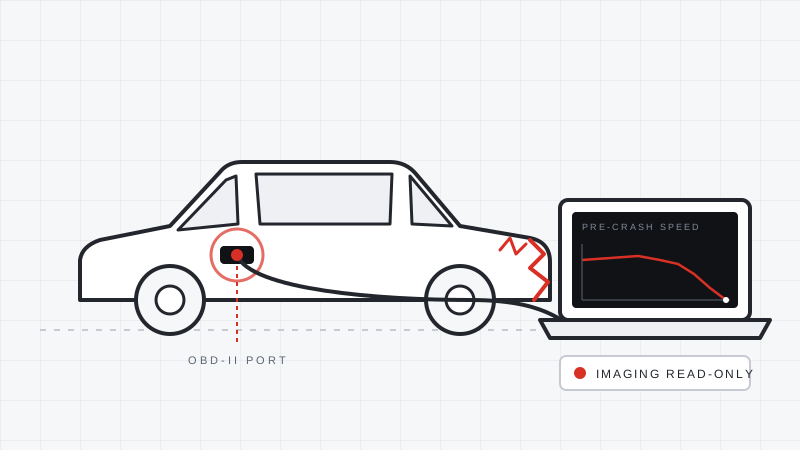
- Through the OBD-II port if the vehicle still powers on. No disassembly, typically under an hour on site.
- Directly at the module if the vehicle is dead or dismantled. The technician locates the airbag control module, usually under the center console or dash, and connects with a vehicle-specific cable.
If the vehicle is outside one of our on-site regions or a site visit is impractical, the module can be removed and shipped to us for a bench download. We document chain of custody in either case.
For contested matters, a joint inspection is the cleanest option from an evidence-handling standpoint: all parties are notified, the download is witnessed, and every side receives the same data file and report.
Step 5: Review the report and, if needed, the analysis
The standard deliverable is the Bosch CDR report, a PDF containing the recorded data tables, graphs, and the manufacturer's data limitations. We typically deliver it within 24 hours of the download. For many claims the report alone answers the question. When a deeper reading is needed, a written forensic analysis interpreting the pre-crash data, delta-V, restraint performance, and consistency with the physical evidence is available, as is expert testimony.
Common pitfalls
Waiting too long to preserve the vehicle. Assuming the police downloaded it when they did not. Letting the module be replaced during a "quick" airbag repair. Reading the speed value without the limitations page and drawing the wrong conclusion. Each of these is avoidable with an early phone call.
Frequently asked questions
What do you need from me before you can download my vehicle?
Written consent from the registered owner, or a court order, plus the VIN so we can confirm coverage. If the vehicle was declared a total loss and the insurer has taken title, we ask the insurer for consent.
How long do I have before the data is gone?
There is no expiration inside the module, but the module itself is often replaced during repair or lost when a total loss is sold at auction, which can happen within weeks. Preserve first, then schedule.
Will the download damage the car or erase the data?
No. The Bosch CDR download is read-only. It does not alter the stored event and does not affect the vehicle's airbag system.
Can you download the other driver's car?
Only with that vehicle owner's written consent or a court order. Obtaining either is handled by the attorneys or insurers involved. Once authorization exists, we can coordinate a joint inspection so all parties receive the same data.
Need a Vehicle Imaged?
On-site downloads in Southern California, the San Francisco Bay Area, Las Vegas, Washington, D.C., and Fort Lauderdale. Nationwide mail-in service for modules.