Key Takeaways
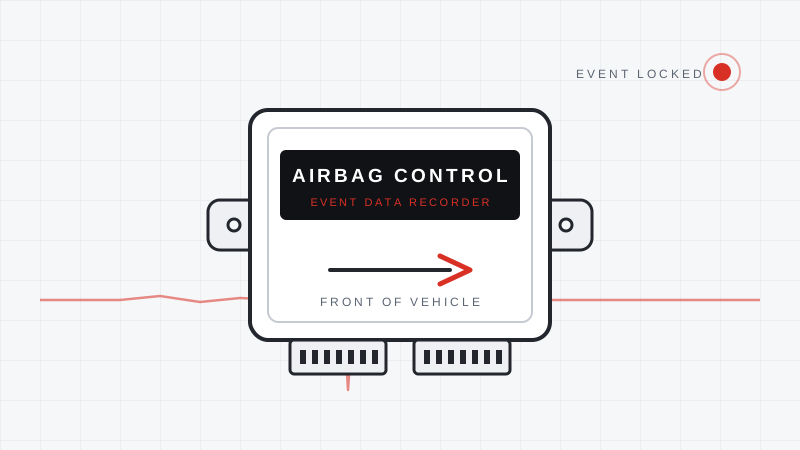
- An EDR is a function inside the airbag control module, not a separate device, and it only saves data when it senses a crash-level event.
- It typically stores at least five seconds of pre-crash data: speed, throttle, brake, and often steering, seatbelt status, and more.
- Federal rule 49 CFR Part 563 standardizes what is recorded on most vehicles from model year 2013 onward.
- The data is read with the Bosch Crash Data Retrieval (CDR) tool and is widely accepted as evidence in claims and litigation.
What an EDR actually is
The term "black box" is borrowed from aviation, but a car's event data recorder is far simpler than a flight recorder. In most passenger vehicles the EDR is not a separate box at all. It is a recording function built into the airbag control module (ACM), the same unit that decides when to fire the airbags and seatbelt pretensioners. Some manufacturers call it the restraint control module (RCM) or sensing and diagnostic module (SDM), but the job is the same.
Because the module already monitors crash sensors, wheel speeds, and the vehicle's data network to make its deployment decision, it is in a natural position to take a snapshot of that information when something violent happens. That snapshot is the event record.
When it records, and when it does not
An EDR is not a dash cam and it is not a trip logger. It continuously buffers a few seconds of data in volatile memory, and only commits a permanent record when an algorithm-enable event occurs: a sudden change in velocity large enough to wake the airbag algorithm. Two categories matter:
- Deployment events. The airbags or pretensioners fired. This record is locked and cannot be overwritten.
- Non-deployment events. The algorithm woke up but decided the crash was not severe enough to deploy. These records are stored, but on many vehicles they can be overwritten by later events, which is one reason a prompt download matters.
Everything else is discarded. The module does not keep a history of your commute, does not record location on most platforms, and does not capture audio or video.
What the black box records
Since model year 2013, U.S. federal regulation 49 CFR Part 563 has required that any light vehicle equipped with an EDR record a standard set of data elements in a standard format. The required elements include:
| Data element | What it tells an investigator |
|---|---|
| Pre-crash vehicle speed (5 s before impact) | How fast the vehicle was traveling and whether it was slowing or accelerating. |
| Accelerator pedal position | Whether the driver was on the gas, and how hard. |
| Service brake on/off | Whether, and roughly when, the brakes were applied. |
| Longitudinal delta-V | The change in velocity during the crash, the best single measure of severity. |
| Maximum delta-V and time to max | How hard and how quickly the impact developed. |
| Driver seatbelt status | Whether the driver's belt was buckled at the time of the event. |
| Airbag warning lamp status | Whether the restraint system was reporting a fault before the crash. |
| Frontal airbag deployment timing | When each stage fired relative to the moment of impact. |
| Multi-event flag and time between events | Whether more than one impact occurred and how far apart. |
| Ignition cycles at crash and at download | A check that the recorded event belongs to the crash being investigated. |
Many manufacturers record far more than the minimum. Depending on make, model, and year you may also see steering wheel angle, lateral delta-V, engine RPM, cruise control state, ABS and stability control activity, individual wheel speeds, occupant size classification, and passenger seatbelt status. Newer vehicles often sample at higher rates and over longer windows than the regulation requires.
From the field
The five-second pre-crash table is where most disputes are decided. A vehicle showing 100 percent throttle and no brake in the last second before a rear-end impact tells a very different story than one showing brake-on for three seconds. The chart on our home page is an example of this data plotted over time.
How the data is retrieved
The industry-standard method is the Bosch Crash Data Retrieval (CDR) tool, which covers the large majority of vehicles sold in the United States. A certified technician can image the module two ways:
- Through the diagnostic link connector (DLC). If the vehicle still powers up, the technician connects to the OBD-II port under the dash and reads the module in place. This is the fastest option and requires no disassembly.
- Directly at the module. If the vehicle is too damaged to power on, or has been totaled and stripped, the airbag control module is located and connected with a vehicle-specific cable. The module can also be removed and shipped to a technician for a bench download.
The download is read-only. Imaging does not alter or erase the stored event, and the CDR software produces a report with a hash value so that anyone can confirm the file has not been modified. A handful of manufacturers, notably Tesla, use their own retrieval tools rather than Bosch, and some older or imported vehicles are not supported at all. We check coverage by VIN before every job.
Why the data matters
Witnesses estimate. Drivers remember selectively. Skid marks fade and modern anti-lock brakes leave few of them anyway. The EDR records numbers, time-stamped, without opinion. That is why it is used by:
- Attorneys in personal injury, wrongful death, and traffic cases, to establish or challenge speed, braking, and seatbelt use. See our guide on how to obtain EDR data after a crash in California.
- Insurance adjusters and SIU investigators to resolve liability disputes, verify injury claims against delta-V, and detect staged collisions.
- Accident reconstructionists as a foundation for a full reconstruction, combined with scene evidence, vehicle damage, and physics.
- Vehicle owners who need independent proof of what happened when the other party's account does not match.
Courts across the country have admitted EDR evidence for more than two decades. The data is not infallible, and a competent analyst will always review the manufacturer's data limitations before relying on any single value, but as a starting point it is the most objective account of a crash that exists.
Why timing matters
Two things threaten the data after a crash. First, if the vehicle is repaired, the airbag control module is usually replaced, and the old one is discarded. Second, if the vehicle is driven or towed carelessly, a later non-deployment event can overwrite an earlier one on some platforms. If a vehicle is at a tow yard or salvage auction, the clock is running. A preservation letter and a prompt download are the safest course.
Frequently asked questions
Does every car have a black box?
Nearly all new passenger vehicles sold in the United States are equipped with an EDR, and Part 563 standardizes what is recorded on vehicles built from model year 2013 onward that have one. Coverage is not universal, so we verify by VIN before scheduling.
Does the EDR record all the time?
No. It continuously buffers a few seconds of data but only writes a permanent record when it senses a crash-level event. It does not store driving history, location, or audio.
How accurate is EDR speed data?
Recorded speed comes from wheel speed sensors and is generally accurate under normal traction, but wheel slip, brake lock-up, tire size changes, and vehicle-specific limitations can introduce error. A qualified analyst reviews the limitations page and other evidence before relying on a single value.
Need a Download?
On-site in Southern California, the San Francisco Bay Area, Las Vegas, Washington, D.C., and Fort Lauderdale, or mail-in from anywhere in the U.S. Standard CDR report typically within 24 hours.