Key Takeaways
- The airbag control module (ACM) holds the EDR data and can be removed and imaged on a bench with the Bosch CDR tool.
- Disconnect the battery and wait at least ten minutes before touching any restraint component.
- Photograph everything, label the connectors, and ship with tracking. Chain of custody starts the moment the module leaves the car.
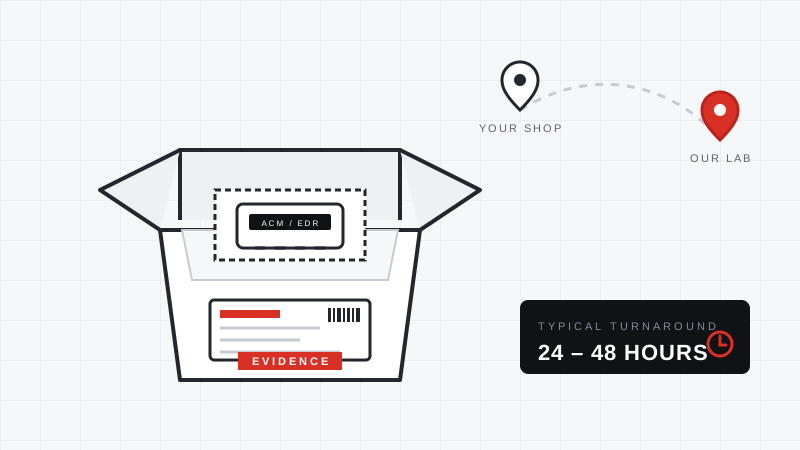
- Typical turnaround is 24 to 48 hours from receipt, and the module is returned with the report.
When a mail-in download makes sense
On-site imaging through the diagnostic port is the simplest option when a technician is nearby and the vehicle still powers on. A mail-in bench download is the better choice when:
- the vehicle is outside one of our on-site regions and a site visit would cost more than the download;
- the vehicle is too damaged to power on, has been partially dismantled, or the module has already been pulled by a shop;
- the vehicle is about to be released, repaired, or sold at auction, and preserving the module is faster than preserving the whole car;
- a salvage yard or body shop has the module in hand and simply needs someone qualified to read it.
Repair shops, salvage operators, and independent adjusters use this route routinely. If you have never done it, we will walk you through it by phone.
Before you start: coverage and authorization
Two things first. Send us the VIN so we can confirm the module is supported by the Bosch CDR tool and tell you exactly which module to pull. Then make sure you have the authority to download: written consent from the registered owner, or a court order. Our guide on obtaining EDR data after a crash explains who can authorize a download.
Safety warning
The airbag control module is part of a live pyrotechnic system. Never remove it with the battery connected. Disconnect the negative battery terminal, wait at least ten minutes for the backup capacitors to discharge, and never probe the connectors with a meter or test light. If the vehicle has undeployed airbags and you are not comfortable with the work, have a qualified shop remove the module.
Step 1: Locate the module
Location varies by manufacturer, but the module is almost always mounted to the floor near the vehicle's centerline so it can sense crash pulses from every direction. Common locations:
| Typical location | Common on |
|---|---|
| Under the center console, between the front seats | Most GM, Ford, Toyota, Honda, Hyundai, Kia |
| Under the dash on the transmission tunnel, behind the radio or HVAC unit | Many Stellantis (Chrysler, Dodge, Jeep, Ram), Nissan, Subaru |
| Under the driver's or passenger's front seat | Some Mazda, older Honda, some European brands |
| Behind the kick panel or under the rear seat | Less common, some trucks and vans |
The module is a metal or plastic box roughly the size of a paperback book, usually with one or two large multi-pin connectors and an arrow molded into the housing that points toward the front of the vehicle. Labels often read "Airbag," "SRS," "Restraint Control Module," or "Sensing and Diagnostic Module." Tell us the VIN and we will send the exact location and photos for that vehicle.
Step 2: Photograph, label, and remove
- Disconnect the battery and wait ten minutes. If the battery has already been removed or is dead, wait anyway.
- Photograph the module in place before touching it, including the connectors and the mounting orientation. These photos become part of the chain of custody.
- Remove trim as needed to reach the module. Console side panels and the rear console cover usually come off with a few clips and screws.
- Unplug the connectors. Most have a locking lever or slide lock. Release it fully before pulling. Never cut the harness.
- Unbolt the module. Typically three or four bolts, 10 mm or Torx. Keep the hardware with the module.
- Do not open the module, clean it, or attempt to power it. Leave dirt, deployment residue, and damage exactly as found.
Step 3: Package the module
- Place the module in an anti-static bag if available, or wrap it in clean paper. Avoid loose plastic wrap that can trap moisture.
- Pad it inside a rigid box so it cannot shift. Bubble wrap or foam on all sides.
- Include a printed copy of the service request and authorization with the vehicle's VIN, your contact information, and the return shipping address.
- Photograph the packaged box before sealing. Seal with tamper-evident tape if the matter is in litigation.
An undeployed airbag control module contains no explosive material itself, so it ships as ordinary freight. It is the airbags and pretensioners that are regulated, not the control module.
Step 4: Ship with tracking
Use any carrier that provides tracking and a signature on delivery. Contact us before shipping so we know the module is coming, can confirm the shipping address, and can log the tracking number. For litigation matters we record the date and time of receipt, the condition of the package, and photographs of the module on arrival.
Step 5: What happens on our bench
When the module arrives we connect it to the Bosch CDR tool through a vehicle-specific direct-to-module cable and a bench power supply. The download is read-only and does not alter the stored data. The software produces a report with a file hash so the data file can be verified later. Typical turnaround is 24 to 48 hours from receipt. You receive the CDR report as a PDF, the raw data file on request, and the module is shipped back to you. A full forensic analysis interpreting the data is available as an additional service.
Not sure what the report will show? Read what an event data recorder records for a breakdown of the data elements.
Frequently asked questions
Will removing the module erase the crash data?
No. The event record is stored in non-volatile memory and survives without power. Removing the module does not affect it.
Can a body shop or salvage yard send the module on my behalf?
Yes, and this is common. The shop still needs the owner's authorization, and we recommend they photograph and document the removal for chain of custody.
What if the module was already replaced during repair?
Ask the shop whether the old module was retained. Some shops keep them for a period. If it was discarded, the data is gone, which is why we urge preservation before any repair begins.
Do you need the whole vehicle for a full report?
No. The standard Bosch CDR report is produced from the module alone. A full accident reconstruction benefits from vehicle inspection, photographs, and scene evidence, which can be supplied separately.
Ready to Ship a Module?
Contact us first for the shipping address, the authorization form, and module location for your specific vehicle.