Key Takeaways
- Nearly all light vehicles sold in the U.S. since model year 2013 have an EDR, and most built in the years before do too.
- Having an EDR and being downloadable are different questions. Coverage depends on whether Bosch or the manufacturer has released a supported interface for that vehicle.
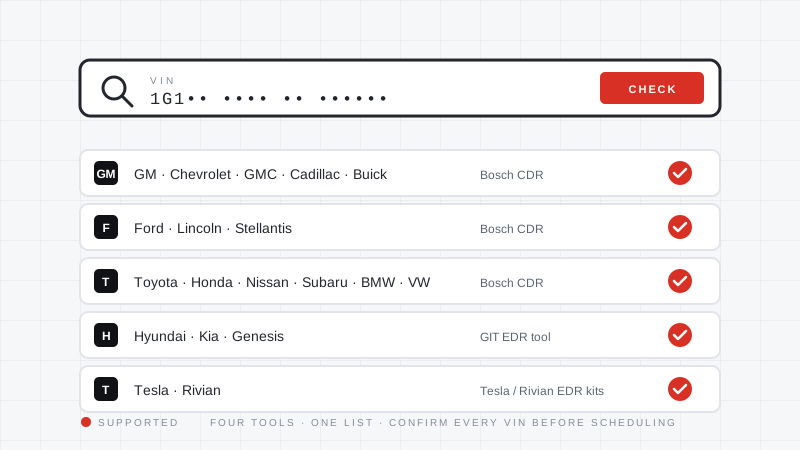
- We image vehicles with four tools: the Bosch CDR tool for most brands, the GIT EDR tool for Hyundai, Kia, and Genesis, the Tesla EDR kit, and the Rivian EDR Recovery Kit.
- Our supported vehicle list (Rev. September 2026) combines all four into one document you can search by make and model.
- A listed vehicle is not a guarantee. Module damage, loss of power, or an unsupported part number can still prevent retrieval, so we confirm every VIN before scheduling.
Having an EDR versus being downloadable
Two questions get mixed together constantly. The first is whether the vehicle records crash data at all. For anything built in the last ten to fifteen years, the answer is almost always yes. Federal rule 49 CFR Part 563 standardized what an EDR must record on light vehicles from model year 2013 onward, and manufacturers had been fitting recorders voluntarily for years before that. Our EDR explainer covers what the module stores.
The second question is whether anyone outside the manufacturer can read it. That depends on whether a retrieval tool exists for the specific module in that specific vehicle. The Bosch Crash Data Retrieval (CDR) tool is the industry standard and is licensed by most manufacturers, but each one joined at a different time and some have never joined. A 2016 vehicle from one brand may be fully supported while a 2016 vehicle from another is not.
Our supported vehicle list
Rather than maintain a summary table that goes stale, we publish a single document listing every U.S.-market vehicle we can currently image, by make, model, and model year. It combines coverage from the four tools we use:
- Bosch Crash Data Retrieval (CDR) tool, currently version 26.1. Covers the large majority of brands sold in the United States, including GM, Ford, Stellantis, Toyota and Lexus, Honda and Acura, Nissan and Infiniti, Mazda, Subaru, Mitsubishi, Volvo, BMW, Mercedes-Benz, Volkswagen, Audi, Porsche, and many more. GM, Ford, and Stellantis coverage reaches back furthest, in some cases to the late 1990s.
- GIT EDR tool for Hyundai, Kia, and Genesis. These brands are not read with the Bosch tool. Coverage begins with model year 2013 vehicles built on or after September 1, 2012.
- Tesla EDR kit for every Model S, Model 3, Model X, Model Y, and Cybertruck, through either an in-vehicle or direct-to-module download. The original 2008 to 2012 Roadster has no EDR.
- Rivian EDR Recovery Kit for the R1T and R1S from model year 2022, the EDV and RCV delivery vans from 2022, and the R2 from 2027. Rivian data is retrieved from the restraints control module after it is removed from the vehicle.
Download
Autoloop EDR Supported Vehicle List, U.S. Market, Rev. September 2026 (PDF, 6 pages). Brands are alphabetical; each model lists its supported model years, and a symbol marks which tool applies.
The list is restricted to vehicles built for the U.S. market. Canada-only, Mexico-only, European, and Asian-market versions of the same models are not included even when the nameplate matches. Some vehicles support only certain modules, so the coverage notes inside the Bosch software are consulted for each job.
If a vehicle is not on the list
A few manufacturers and model years have no public retrieval tool at all. In those cases the data may be obtainable only from the manufacturer under legal process, which is a conversation for the attorneys involved. If you do not see a vehicle, send us the VIN anyway. Coverage is added with every tool release, and a vehicle that was unsupported last year may be supported now.
Heavy trucks and commercial vehicles
Class 7 and 8 trucks, and many medium-duty commercial vehicles, do not have a passenger-car style EDR in the airbag module. Instead, the engine control module from manufacturers such as Cummins, Detroit Diesel, PACCAR, Volvo, and Mack records hard-brake and last-stop events. These are read with manufacturer diagnostic software, often referred to as HVEDR downloads, and require different equipment and training. If your matter involves a truck, say so when you call so we can route it correctly.
How to check a specific vehicle
Coverage is specific enough that the only safe method is a lookup against the current list, and even a listed vehicle is confirmed by VIN before we schedule.
- Find the VIN. It is on the driver's side dash at the base of the windshield, on the driver's door jamb sticker, on the registration, and on the insurance card.
- Send it to us by text, email, or the request form. We check it against the current Bosch coverage list and tell you whether the vehicle is supported through the diagnostic port, requires a direct-to-module connection, or needs a manufacturer tool.
- Or check it yourself. Open our supported vehicle list, search for the make and model, and confirm the model year range. If the entry carries a symbol, it tells you which tool we use for that vehicle.
From the field
The most common surprise is not an unsupported vehicle. It is a supported vehicle whose module was already replaced during repair. Coverage only matters if the original module still exists. If the car has been to a body shop since the crash, ask whether the airbag module was swapped before you plan a download.
Why coverage changes over time
Bosch releases CDR software updates roughly twice a year, and the GIT, Tesla, and Rivian lists are revised on their own schedules. Each release adds vehicles, and manufacturers sometimes add retroactive coverage for older model years. We update our combined list when the underlying tools change. If you were told a vehicle could not be imaged a year or two ago, it is worth asking again.
Frequently asked questions
Does my car have a black box?
If it was built for the U.S. market in roughly the last fifteen years, almost certainly yes. Whether the data can be downloaded by an independent technician depends on the make and model year, which we confirm by VIN.
Can you download a Tesla?
Tesla vehicles store EDR data but require Tesla's own retrieval kit rather than the Bosch CDR tool. Contact us and we will explain the current process for your situation.
What if the vehicle is older than the coverage list?
Many older vehicles, especially GM and Ford, are supported back to the early 2000s. For others, there may be no public tool. We check the exact VIN before saying no.
Not Sure If Your Vehicle Is Covered?
Send us the VIN. We confirm it against the current coverage lists and tell you the next step, usually the same day.