Key Takeaways
- An EDR download typically costs less than a single hour of litigation and often ends the dispute outright.
- It is strongest on speed, braking, throttle, and seatbelt questions, and on confirming whether a claimed impact actually happened.
- Order it early. Modules are lost to repair and salvage far faster than claims resolve.
- A joint download, with both carriers' representatives present, removes most later arguments about the data.
- The report needs a qualified reader. Pre-crash speed and delta-V have documented limitations that a careless reading will miss.
Why adjusters order downloads
A claim with disputed liability costs money every week it stays open: adjuster time, independent appraisals, recorded statements, and eventually defense counsel. Witness accounts are inconsistent, modern anti-lock brakes leave few skid marks, and dash cams are still the exception. The airbag control module in each vehicle, by contrast, stored a time-stamped record of what the vehicle was doing in the seconds before impact. Reading it is usually faster and cheaper than any other way of resolving the same question. Our EDR explainer covers exactly what is recorded.
Disputes the data settles best
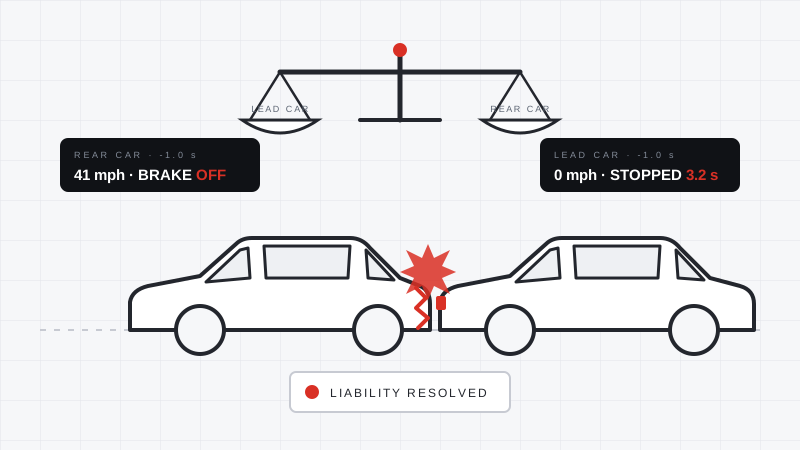
Rear-end collisions with a sudden-stop defense
The rear driver says the lead vehicle stopped without warning. The lead driver says they were stopped for several seconds. The lead vehicle's pre-crash table shows its speed over the five seconds before impact. The rear vehicle's table shows whether, and when, its brakes were applied. Together they usually answer the question in one page.
Speed allegations
One party claims the other was speeding. The pre-crash table records vehicle speed at intervals. Read with the manufacturer's limitations in mind, it establishes a range that is far more reliable than estimates from damage alone.
Seatbelt use
Many modules record whether the driver's belt, and often the front passenger's, was buckled at the time of the event. This bears directly on injury causation and, in many jurisdictions, on comparative fault. It is one of the most frequently misstated facts in claimant statements and one of the easiest to verify.
Low-impact and staged collisions
When an injury claim seems out of proportion to the damage, delta-V tells you how severe the impact actually was. When a loss is suspected of being staged, the pre-crash data often reveals a pattern that does not match the reported story: a vehicle accelerating into the impact rather than braking, or an event that occurred at a time inconsistent with the reported loss. Special investigation units use this routinely.
Phantom-vehicle and swerve claims
A driver reports swerving to avoid an unidentified vehicle. Steering wheel angle, where recorded, and the timing of brake and throttle inputs show whether an evasive maneuver actually happened and when. This is especially useful in single-vehicle losses where uninsured motorist coverage is in play.
Intersection and left-turn disputes
Each vehicle's speed and braking profile, combined with the time between events if multiple impacts occurred, helps a reconstructionist place the vehicles in the seconds before contact. The EDR alone rarely resolves these, but it anchors the reconstruction in measured values instead of estimates.
When to order a download
A download is not necessary on every file. It earns its cost when one or more of the following is true:
- Liability is disputed and the vehicles' accounts conflict on speed, braking, or sequence.
- Airbags deployed, which guarantees a locked event record exists.
- Seatbelt use is in question.
- The loss has indicators that warrant a special investigation referral.
- The vehicle is a total loss and about to be sold at salvage, which is the last chance to preserve the module cheaply.
Conversely, a clear-liability, low-severity loss with consistent statements rarely needs one.
Timing and preservation
The data does not expire inside the module, but the module itself is fragile in practice. When a vehicle with a deployed airbag is repaired, the module is almost always replaced and the original discarded. When a total loss goes to auction, it can be out of the country within weeks. The practical rule is to decide about the download at first notice of a disputed loss, not after the file has aged.
If the vehicle is in your salvage network, a download can usually be done on the lot. If it is at a body shop, ask the shop to hold the original module even if repairs proceed. If the vehicle is outside one of our on-site regions, the module can be removed and mailed for a bench download.
Joint downloads and authorization
For the vehicle your insured owns, their written consent is what we need. For the other party's vehicle, their consent or a court order is required, and that is between the carriers and their counsel. In practice, carriers on both sides frequently agree to a joint inspection: both are notified, the download is witnessed, and each receives the same data file and report with matching hash values. This removes nearly every later argument about how the data was obtained and often leads directly to a resolution conversation. See our guide to the download process in California.
Reading the result correctly
The standard deliverable is the Bosch CDR report, usually within 24 hours. For most files the pre-crash table and the event summary answer the question. Two cautions:
- Read the manufacturer's data limitations before quoting any number. Pre-crash speed is wheel-based and sampled at intervals. Delta-V is measured at the module, not the center of gravity. Our overview of what is in the report walks through this.
- Confirm the recorded event is your loss. Check ignition cycles between the event and the download, and the number of events stored.
When the dispute is headed toward litigation, or the numbers are close to a threshold that matters, a written forensic analysis puts the data in context and holds up under cross-examination.
Cost perspective
A standard download and report costs a fraction of a single deposition. On a file with meaningful injury reserves and disputed liability, it is among the highest-return investigative steps available, and it is often the step that makes the other steps unnecessary.
Frequently asked questions
Can we download the claimant's vehicle?
Only with the vehicle owner's written consent or a court order. Carriers frequently arrange this through a joint inspection agreement. Obtaining consent is handled between the parties, not by us.
How fast can you get to a vehicle?
In Southern California and our other on-site regions, usually within a few business days, often sooner for a vehicle about to be released or sold. Nationwide, modules can be mailed to us for a bench download with 24 to 48 hour turnaround.
What if the vehicle has already been repaired?
Ask the shop whether the original airbag control module was retained. If it was replaced and discarded, the data is gone. This is why we encourage deciding on a download at first notice.
Does the download affect the vehicle or its value?
No. The Bosch CDR download is read-only. It does not alter the data or the airbag system, and it leaves no trace on the vehicle.
Disputed Liability on a File?
On-site downloads in Southern California, the San Francisco Bay Area, Las Vegas, Washington, D.C., and Fort Lauderdale, nationwide mail-in, and joint inspections coordinated with the other carrier.